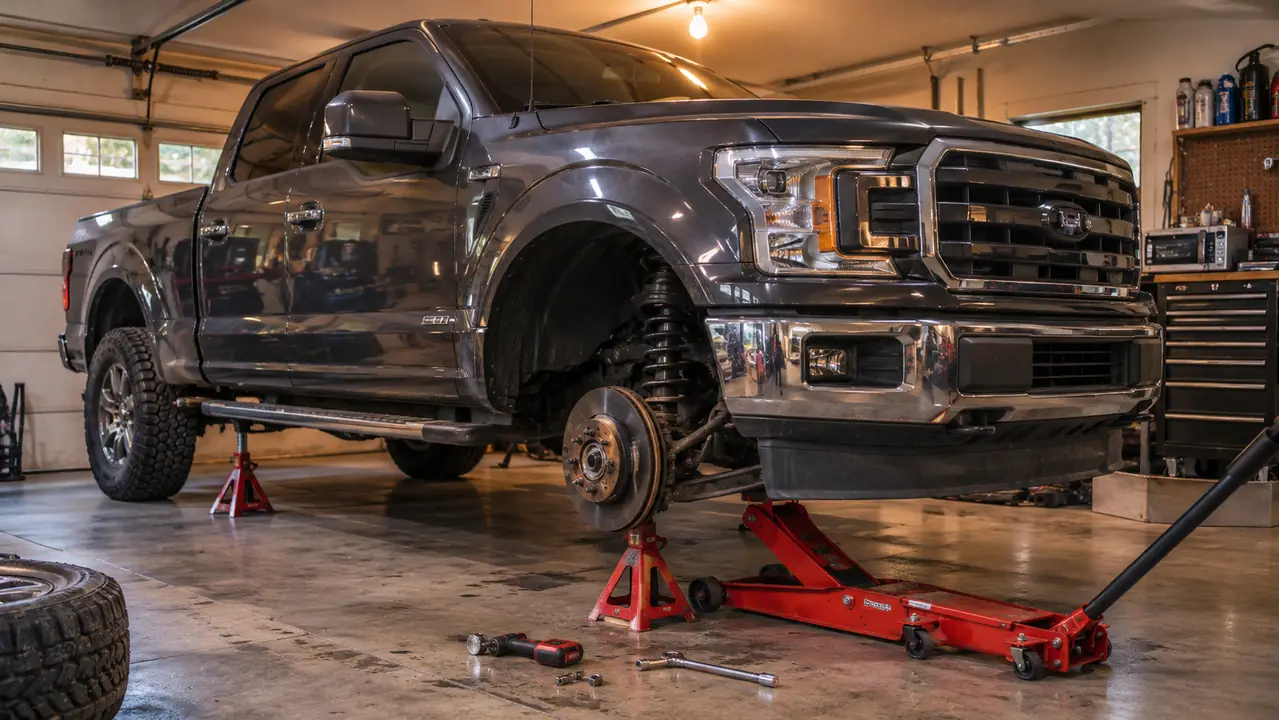
The first time I lifted a truck in my own garage, I did it the lazy way, one corner at a time with the factory scissor jack, and I paid for it with a sore back and a truck that wobbled every time I bumped it. That was thirty years ago. Since then I have lifted more trucks and loaders than I can count, and the rule I teach anyone who asks is simple: the jack only lifts the truck, and something else has to hold it. That something else is a pair of jack stands, and the jack that does the lifting in my garage is the ARCAN 3-Ton Aluminum Low Profile Floor Jack.
I have owned this ARCAN for about five years now. It lives under the workbench in my two-car garage outside Fresno, and it has been under my 2011 Ford F-150 more times than I can count, plus my wife Marlene's 2016 Honda CR-V, which sits low enough that most floor jacks will not slide under it. This one does. I am writing this because every year I see someone in an online group lifting a truck with a scissor jack and a cinder block, and I would rather you learn the safe way from a guy who has done it wrong and lived. So here are the exact steps I use, what the ARCAN does well, and where it will not save you from your own bad habits.
The jack that has held my F-150 for five years
The ARCAN 3-Ton Aluminum Low Profile Floor Jack lifts to 18 inches, slides under low cars, and weighs 56 pounds, so it is easy to carry out to the driveway. It is the jack I reach for first.
Amazon Check Today's Price on Amazon →Step 1: Pick a level spot and set the parking brake
Before the jack touches the truck, the truck has to be somewhere it cannot roll and cannot settle. I do this on the concrete floor of my garage, which is level. If you are working on a driveway, find the flattest section and check it from a crouch. I have a level spot in the garage, but when I have to work on the driveway, I use a long level on the floor to find the flattest spot, and I am not too proud to move the truck twice. A truck that is tilted sideways is a truck that wants to slide off a jack stand, and that is not a risk worth taking for any job.
Park the truck, put it in Park, or in gear if it is a manual, and set the parking brake hard. I also chock the rear wheels, both sides, even when I am lifting the front. A set of chocks is inexpensive, and it is the best insurance you will buy. On my F-150, the chocks stay behind the rear tires the whole time the front is in the air, and they come out only after the truck is back on the ground.
One more thing before you start: clear the floor. The ARCAN needs a clean path to roll under the truck, and you need a clear spot on both sides for the jack stands. I have tripped over a dropped socket while carrying a loaded jack, and I do not recommend it. Five minutes of tidying beats a trip to urgent care, and it also means you are not hunting for a 13-millimeter socket while the truck is hanging in the air.
Step 2: Find the factory lift points
Every truck has specific places where the frame is strong enough to take the weight of the vehicle. They are in the owner's manual, usually shown as small diagrams, and they are almost always on the frame rails behind the front wheels and ahead of the rear wheels. Do not guess. If you lift on a pinch weld or a body panel, you will bend metal that is expensive to fix. The manual for my F-150 shows them clearly, and I still check it when I am working on a vehicle I do not know.
On my 2011 F-150, the front lift points are on the frame rails, and the rear points are on the axle housing. The axle is a forgiving place to lift because it is solid and built to carry the weight of the truck. The frame rails are too, as long as you center the jack on the rail and not on the edge, where the metal can fold. When in doubt, the owner's manual is the final word, not the internet forum.
This is where a low-profile jack earns its keep. The ARCAN has a minimum height of 3.75 inches, which means it slides under trucks and cars that sit close to the ground. Marlene's CR-V is low enough that my old steel jack would not fit without driving the car up on boards. This one rolls right under. The rating is 3 tons, or 6,000 pounds, which is plenty for a half-ton pickup like mine. The low profile is the reason I bought this jack in the first place, and it is the reason it gets used for every job instead of sitting in a corner.
Step 3: Position the jack and raise the truck
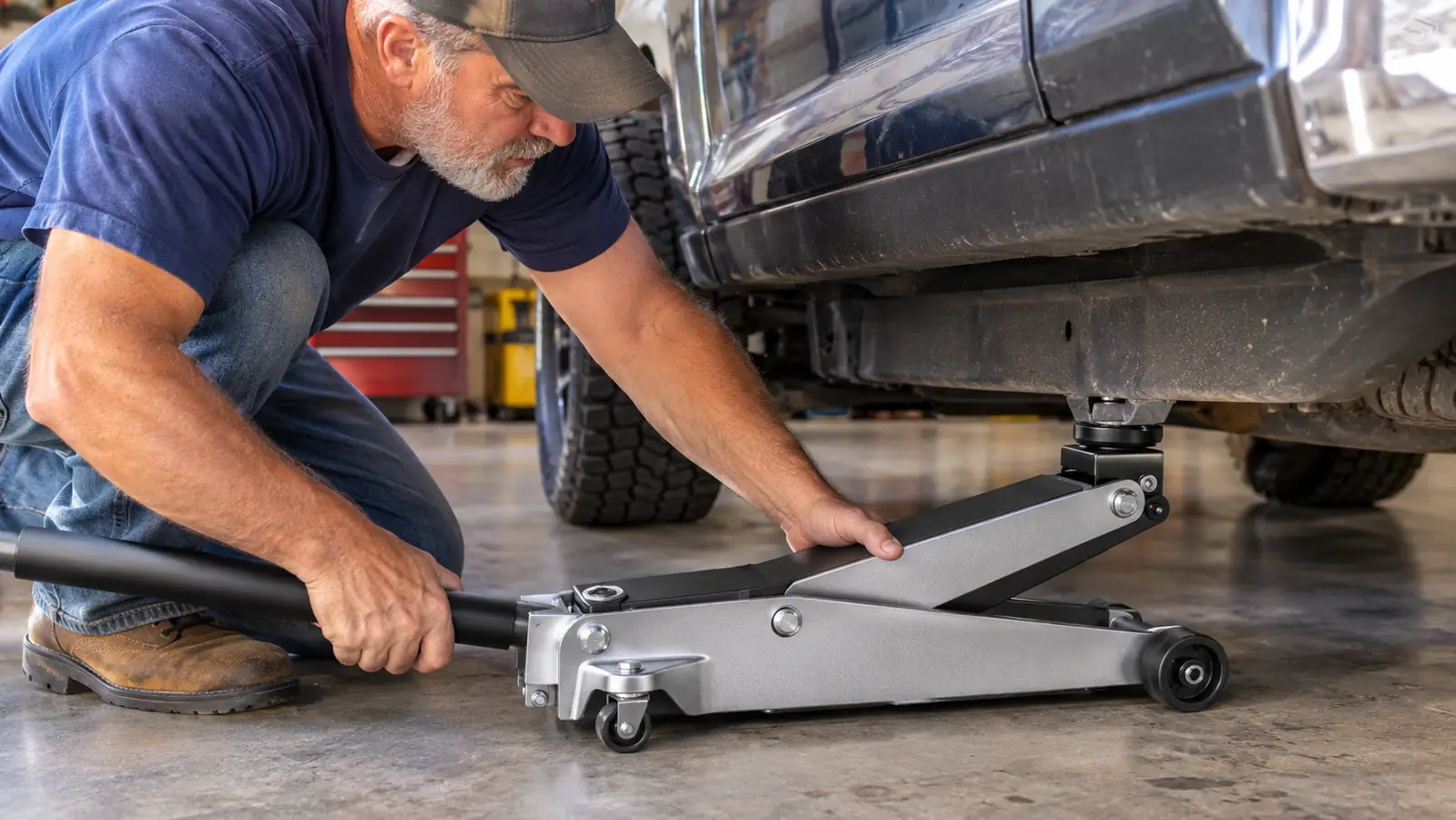
Roll the ARCAN under the truck and line up the saddle, the flat plate on top of the lift arm, with the lift point. Center it under the frame rail, then pump the handle a few times until the saddle just touches the metal. Check that it is square with the rail before you commit to the lift. A jack that is angled under the frame will push the truck sideways as it rises, and that is how stands end up in the wrong place.
Once the saddle is seated, raise the truck until the tires are just off the floor. Then stop and give the truck a gentle shove with both hands on the bumper. If it rocks solid, keep going. If it moves more than you expect, lower it and recheck the saddle position. This takes thirty seconds, and it has saved me from at least one bad lift that I only caught because I bothered to check before I kept going.
The ARCAN's reinforced lift arm is there for stability under load, and the hydraulic system includes bypass and overload valves to prevent over-extension and keep the lift controlled. I have had this jack under a fully loaded F-150 at its full 18-inch lift height, and it has never once felt like it was working hard. The bypass and overload valves are the kind of detail you do not think about until you need them, and then you are glad they are there. That said, the jack is a lifting tool, not a holding tool. Which brings me to the next step, and it is the one I will not let anyone skip.
Step 4: Set the jack stands before you touch anything
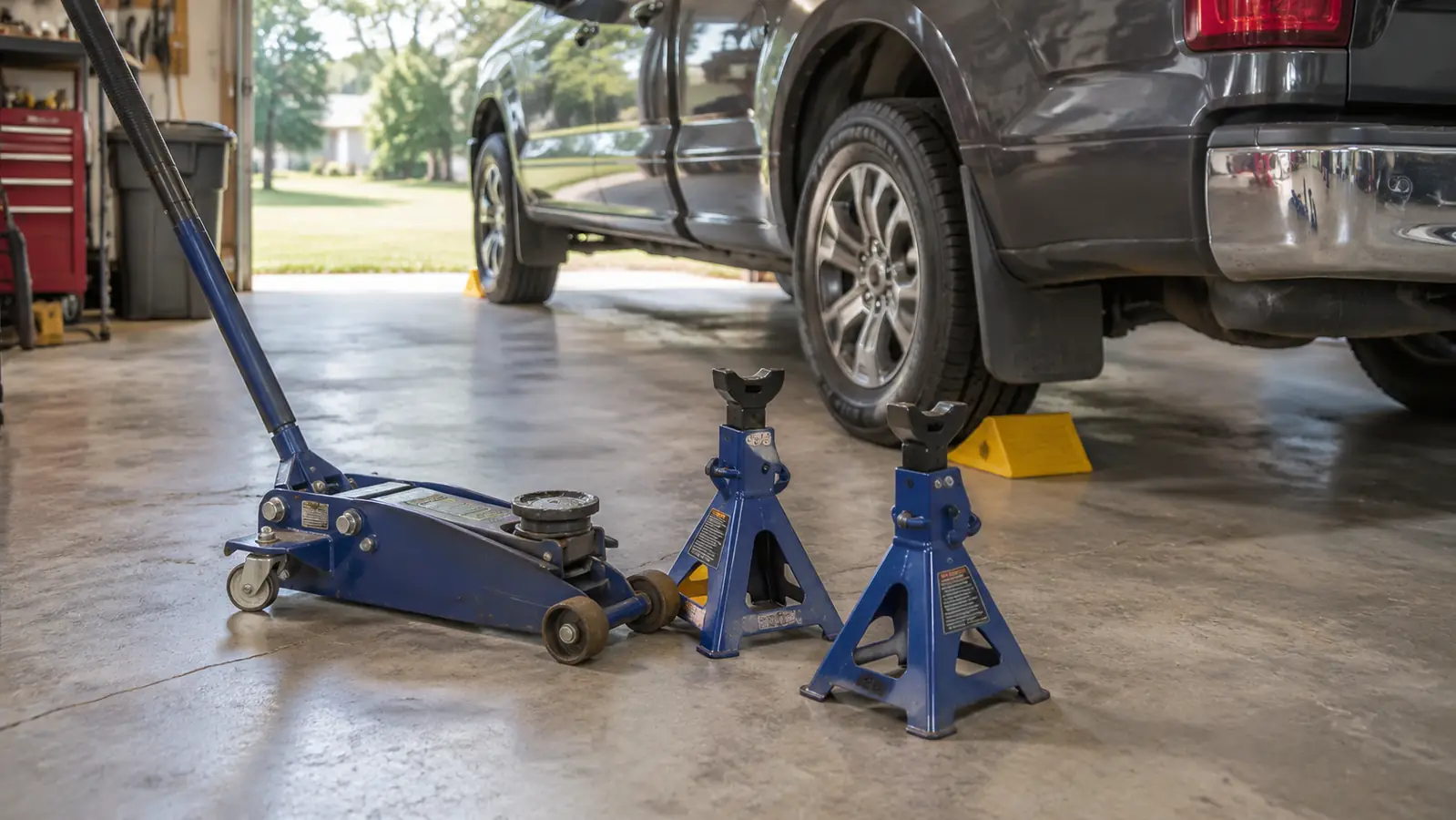
Here is the rule I have repeated to my son Travis since he started working on his own car: the jack lifts the truck, and the jack stands hold the truck. Never get under a vehicle supported only by a floor jack. Hydraulic seals can fail, and a jack can settle or bleed down over time. Jack stands are cheap, your ribs are not, and a truck that drops is not going to wait for you to roll out from under it. I tell Travis the same thing every time he comes over from Sacramento with his own car: stands first, then work.
Set a jack stand under the frame rail on each side, close to the lift point, and adjust them so they are just below the frame. I use the same height on both sides, and I check that both stands are on solid concrete, not on a crack or a piece of debris. Then lower the truck slowly onto the stands until the full weight is on them. You want to hear the stands take the load, not feel the truck settle an inch after you walk away.
Before you slide under the truck, give it the same shove test you did at the start. Push on the bumper from the side, hard. The truck should sit rock solid on the stands. If it rocks, raise it again, adjust the stands, and lower it again. This is not overthinking it. This is the difference between a Saturday project and a hospital visit, and I have seen both in thirty years of turning wrenches.
Step 5: Lower the truck onto the stands, then lower the jack
Lowering is where people get careless because the hard part seems done. Open the release valve just a crack and let the truck settle onto the stands, then close the valve and check the stands. The truck should be sitting level on both stands, with the jack saddle just barely touching the frame. If it is not level, raise it again and reset the stands. Slow is smooth, and smooth is done right the first time.
Once the weight is on the stands, lower the jack the rest of the way and pull it out from under the truck. Give the truck one more shove test, then do your work. When you are done, reverse the process: raise the truck with the jack, pull the stands, and lower it to the ground. I raise it just high enough to clear the stands, never higher than I need to. Every extra inch of lift is extra time the truck spends in the air, and the goal is to get it back on the ground as soon as the job is done. I have watched people leave a truck on a floor jack overnight 'just for a minute,' and the next morning the jack has bled down and the truck is resting on the bump stops. Do not be that guy.
One habit that has served me well: after the truck is back on the ground, I give the ARCAN a quick once-over before it goes back under the bench. I wipe down the lift arm, check the hydraulic unit for leaks, and make sure the handle is seated. A little oil on the lift arm now and then keeps it moving smooth, and it takes about a minute. It came with a one-year warranty, and after five years I have never had to use it. Take care of a good tool and it will take care of you.
What Else Helps
A floor jack and a pair of jack stands are the core of any safe lift, but a few other things make the job easier. I keep a DEWALT 108-piece mechanics tool set in the truck for most bolt work, and a GEARWRENCH 1/2-inch electronic torque wrench for anything that needs to be torqued to spec, like lug nuts and caliper bracket bolts. A short piece of 2x6 under the jack base can help on uneven ground, though on a flat concrete floor I have never needed it.
I also keep a pair of wheel chocks and a good drop light within reach. And I will say this plainly: if you are working on a truck that is too heavy for your jack, do not talk yourself into it. The ARCAN is rated for 6,000 pounds, which covers my F-150 and Marlene's CR-V with room to spare, but a one-ton dually is a different job. Match the tool to the load, every time, and you will never be the guy the story gets told about.
A creeper is nice to have but not required. I have done plenty of jobs on a piece of cardboard. What matters is that you can see what you are doing and that you are not reaching across a gap. A drop light or a headlamp beats a flashlight held in your teeth every time.
Five years and hundreds of lifts later, the ARCAN has never once let me down. I still set the jack stands before I get under the truck, every single time.
Lift your truck the right way, every time
The ARCAN 3-Ton Aluminum Low Profile Floor Jack is the jack I have trusted for five years. It lifts to 18 inches, slides under low vehicles, and weighs 56 pounds. Pair it with a good set of jack stands and you are ready for any job in the driveway.
Amazon Check Today's Price on Amazon →