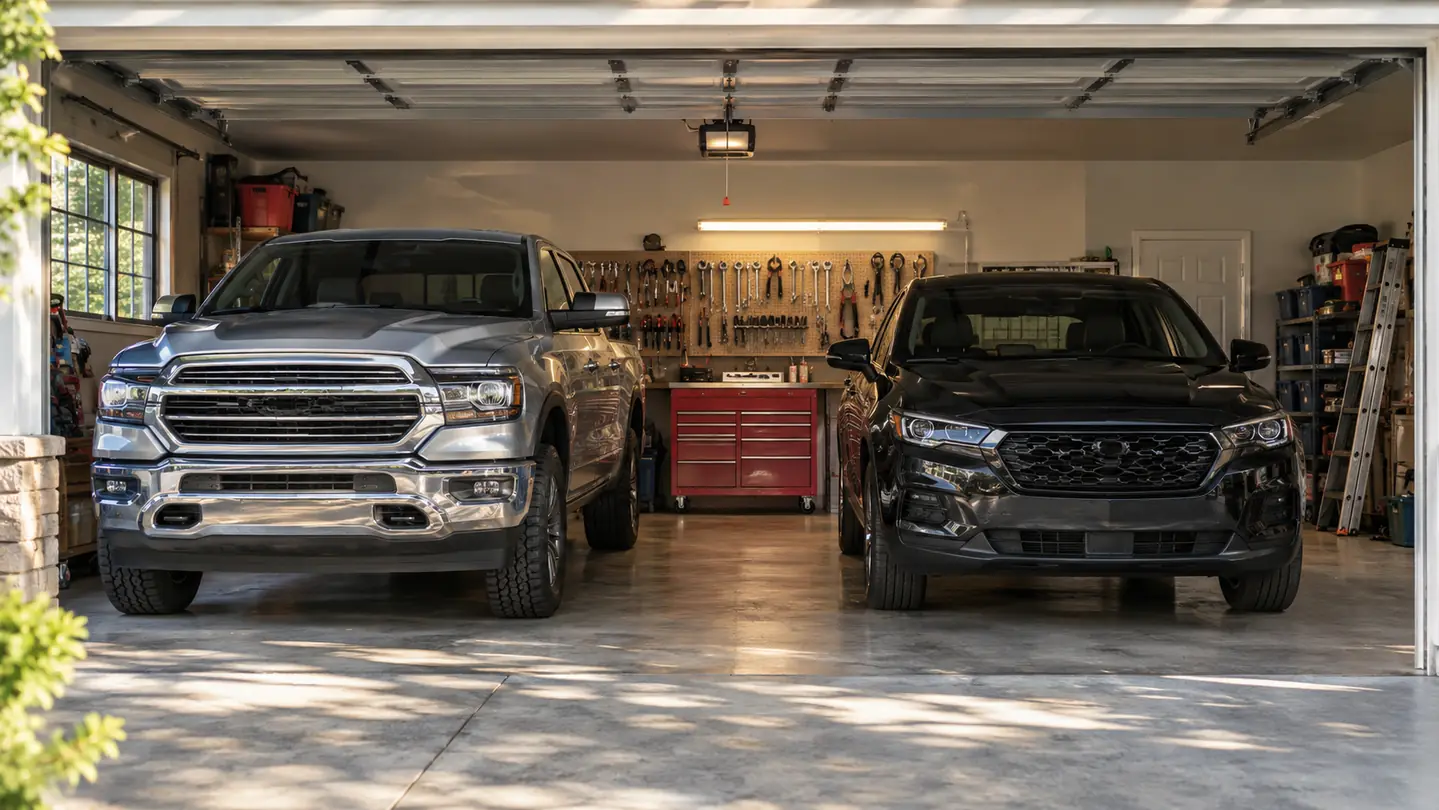
I spent thirty years fixing loaders and graders for the county road department, and most of that time I had a second pair of hands within hollering distance. At home it is different. My garage has one shop light, one rolling tool chest, a pegboard wall, and usually just me. So when Marlene's 2016 Honda CR-V needed new pads and rotors about a year ago, I knew the brake bleeding part was going to be the awkward part. The old way meant asking her to sit in the driver's seat and pump the pedal on my say-so. I would crack the bleeder screw, she would push the pedal, I would close the screw, she would let up. It worked, but it never felt great for either of us. She was doing me a favor, and I could tell.
That job is what finally pushed me to buy the Orion Motor Tech one-man brake bleeding kit. It is a hand vacuum pump with a dial gauge, a set of adapters, silicone hoses, and a blow-molded case to keep it all together. I have had it about a year now, and it has done every brake bleed in this garage since. This is the long-term review I would have wanted before I bought it, written by a guy who has skinned his knuckles plenty and would rather save you a wasted Saturday than sell you anything.
The Quick Verdict
For a home mechanic who works alone, this kit turns a two-person chore into a one-person job. It is not a shop-grade tool, but it does not pretend to be.
Amazon Check Today's Price →Skip the two-person dance.
If you do your own brakes, the Orion Motor Tech kit pays for itself the first time you bleed a caliper without asking for help.
Amazon Check Today's Price on Amazon →How I've Used It
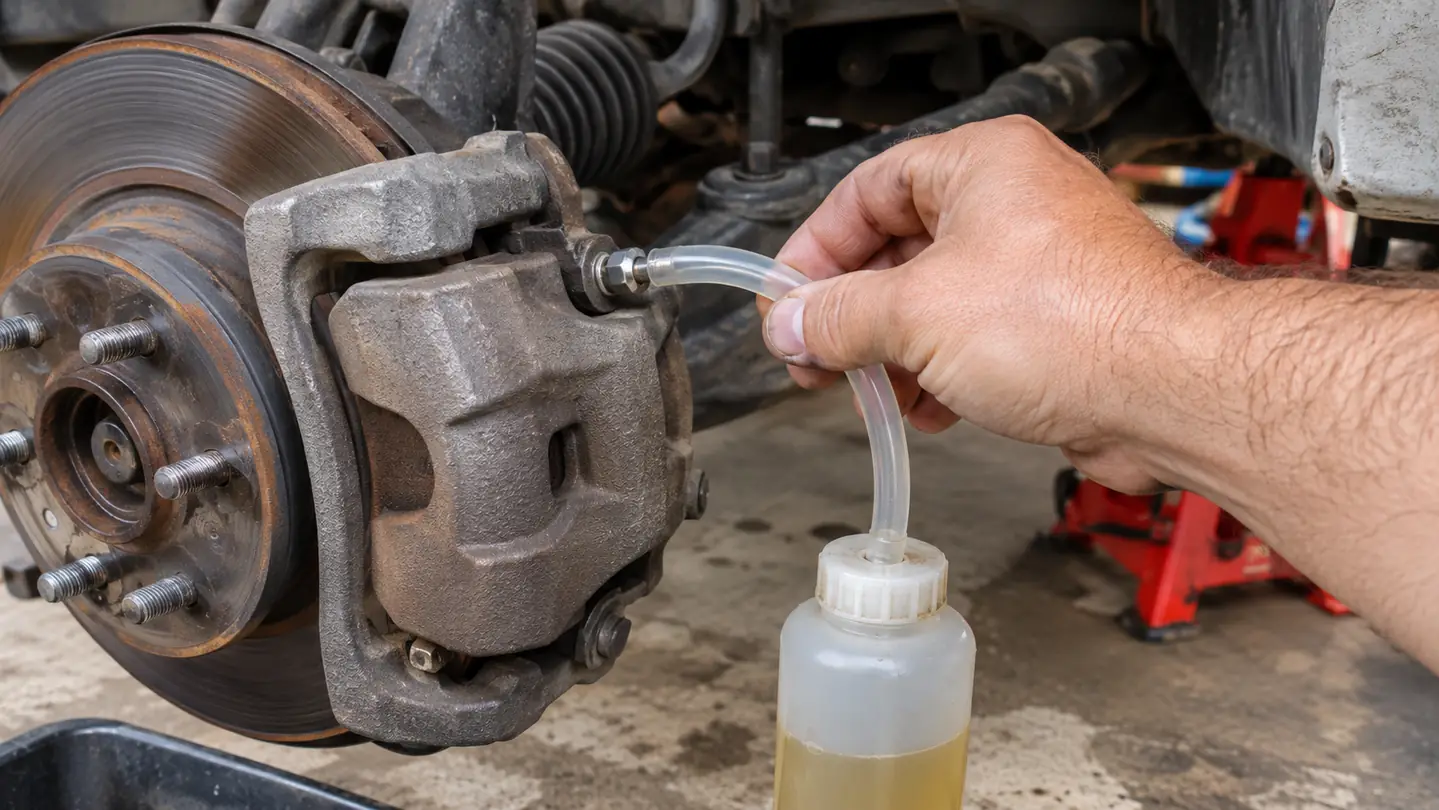
The first real job was the CR-V. I had already replaced the pads and rotors, so the calipers were full of old fluid and the lines had some air from pushing the caliper pistons back. I used my ARCAN low-profile jack to get the CR-V up and set jack stands under the frame. Then I hooked the Orion Motor Tech pump to the bleeder screw on the right rear caliper, opened the screw a half turn, and worked the pump handle until the fluid ran clean. No one in the driver's seat. No yelling back and forth. Just me, the pump, and a steady stream of old fluid.
Since then I have used it a few more times, mostly on the CR-V when I flushed the brake fluid and on Travis's car when he brought it over with a soft pedal. Each time the routine is the same: hook up, pump, watch the fluid, close the screw before the hose comes off. It takes longer to set up the jack stands than to bleed the brakes. That is the honest measure of a tool like this.
I have also used it on Travis's car more than once. He does his own oil changes but he does not own a brake bleeder, so when his pedal went soft he drove over and we ran the same routine. The kit handled a second vehicle without any fuss.
What the Kit Gives You
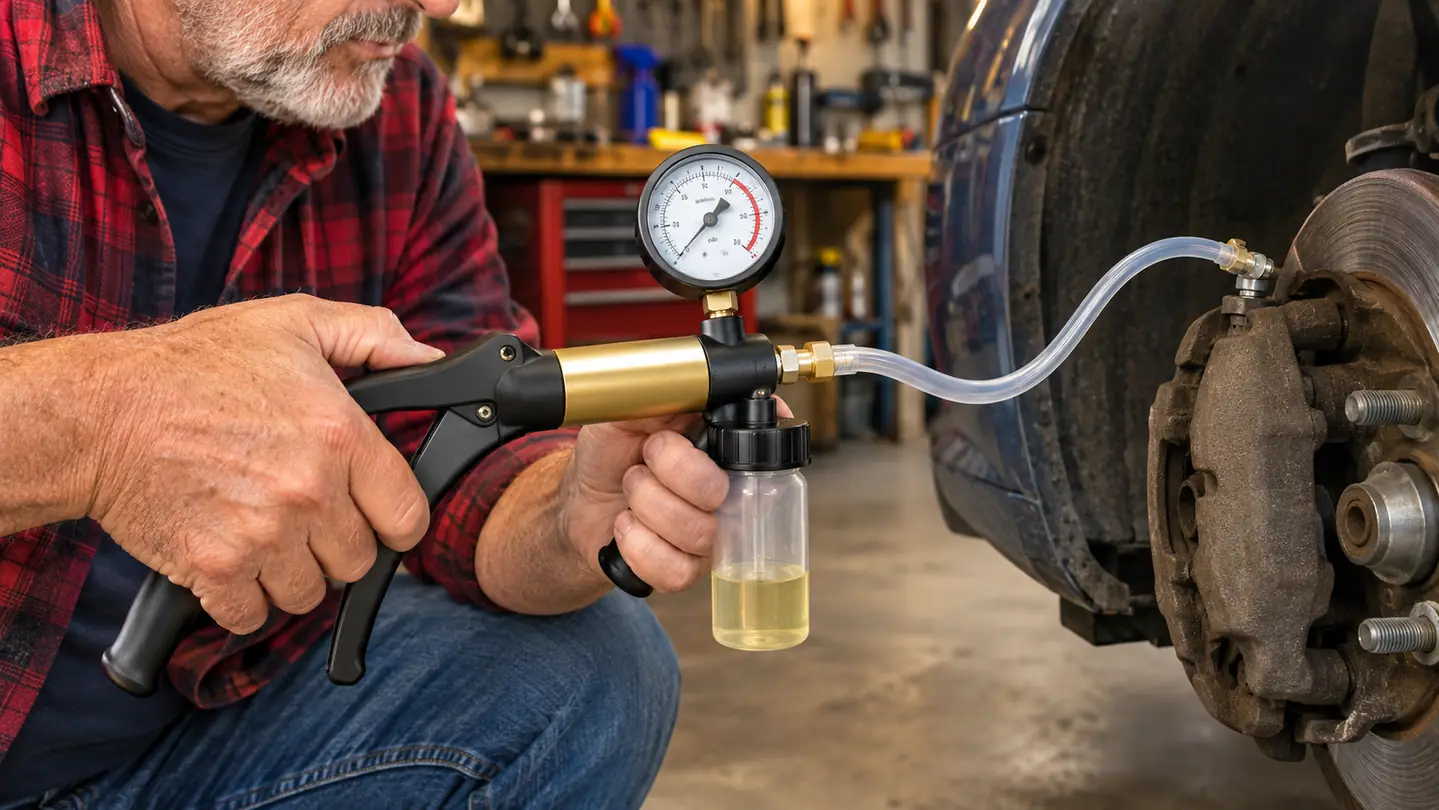
The kit is simple. The main piece is a hand vacuum pump with a dial gauge on top. You work the handle by hand, and the gauge shows how much vacuum you are pulling. That gauge is the part that makes it a real tool instead of a toy. With a plain hose-and-jar setup you never know if you are pulling enough to move fluid or just sucking air around the threads. The gauge answers that question before you ever open a bleeder screw.
The hoses are silicone, which matters more than it sounds. Brake fluid is hard on rubber, and silicone handles the heat and the fluid better than the cheap vinyl tubing I used for years. The adapter set is what lets it fit nearly any vehicle. I have used it on the CR-V and on Travis's car, and the kit had the right fitting both times. Everything lives in a blow-molded case, so the parts do not end up scattered across the workbench.
The case itself is worth a mention. It is a blow-molded box, about ten inches long and a bit under nine inches tall, and the whole thing weighs just over two pounds. I keep it on the shelf above the bench, and it takes up less room than a shop manual. When I need it, I grab the case and everything is right there. For a home garage where bench space is always short, that matters.
How It Handles the Actual Bleeding
The procedure is the same one you would use with a helper, just without the helper. You start at the wheel farthest from the master cylinder, which on the CR-V means the right rear. You attach the hose to the bleeder screw, open the screw, and work the pump until the old fluid comes through. The gauge lets you see when the vacuum is holding. If the hose is seated right, the fluid moves steady and the pedal stays firm.
The one-man part is not a gimmick. It really does let you do the job alone. The dial gauge is the reason I trust it. On a two-person bleed you judge progress by the pedal feel. With this pump, you watch the gauge and the fluid line. When the gauge holds steady, the system is sealed. When it drops, you have a leak at the bleeder screw or the hose connection. That is the kind of feedback that keeps a backyard job from turning into a mystery.
It is also forgiving of a beginner. The first time I used it, I opened the bleeder screw too far and got more air than fluid. The gauge showed the vacuum dropping, so I closed the screw, reseated the hose, and started again. No harm done. You cannot always do that with a power bleeder. With this pump, the mistake costs you a few minutes, not a trip to the parts store.
The best part is the freedom. When Marlene used to help, I felt like I had to work fast so she was not stuck in the driver's seat any longer than necessary. Now I can take my time. I can stop, top off the master cylinder, check the hose connection, and go back to the pump without apologizing to anyone. That sounds like a small thing until you have done it the other way.
Where It Falls Short
It is not a power bleeder, and I would not pretend otherwise. A power bleeder pushes fluid through the system under pressure and can flush a whole system in minutes. This pump pulls fluid through one wheel at a time, which is slower. For a full flush on both vehicles, I budget about an hour and a half, working slowly and checking the master cylinder level between wheels. If you are doing brake work every weekend, that hour and a half adds up.
The other shortfall is the gauge. It is a mechanical gauge, not a precision instrument. For brake bleeding you do not need laboratory accuracy. You need to know whether you are pulling enough vacuum to move fluid, and it does that. But if you are the kind of person who wants exact numbers on everything, this is not that tool. It tells you what you need to know, and it does not pretend to be anything fancier.
The handle can also get old on a long job. Bleeding one caliper is easy. Flushing the whole system means working that handle for a good while, and my hand notices by the end. It is not a reason to avoid the kit, but it is a reason to take a break between wheels. I usually use the pause to check the master cylinder and wipe down the fittings.
One more thing: the case is blow-molded, not a hard-sided professional box. That is fine for a shelf in a home garage. If you throw tools into the back of a work truck every day, you will want to protect the gauge. I keep the case on the shelf, so it has never been an issue for me, but it is worth knowing before you buy.
What I Liked
- Lets one person bleed brakes without a helper
- Dial gauge shows vacuum at a glance
- Silicone hoses resist brake fluid
- Adapter set fits the vehicles I work on
- Blow-molded case keeps parts organized
Where It Falls Short
- Slower than a pressure bleeder on a full flush
- Mechanical gauge is not precision-grade
- You still have to watch the master cylinder level
- Not built for heavy shop use every day
The first time I bled the CR-V's brakes alone, I closed the hood and just stood there for a minute. It had never been that easy.
Alternatives I Considered
Before I bought the Orion Motor Tech kit, I looked at the old two-person method and at pressure bleeders. The two-person method costs nothing, but it costs a Saturday and a patient spouse. Pressure bleeders are faster, but they are more money and more parts to maintain, and for the amount of brake work I do at home, they are overkill. I needed something that sat in the middle.
I also thought about just paying a shop to do the flush. That is a reasonable choice for someone who does not work on cars. But I do this for the same reason most of you do: I like knowing the work is done right, and I like not paying shop rates. The Orion Motor Tech kit sits in the middle. It is not the cheapest way to bleed brakes, and it is not the fastest. It is the most practical for a home garage.
The other option I weighed was a one-way valve hose, the kind that lets you push the pedal and pull fluid out without a helper. I have used those, and they work, but they still tie you to the pedal. You are reaching into the wheel well while the pedal is moving, and that is a good way to get brake fluid on your arm. The pump keeps you out of that position.
Who This Is For
This kit is for the home mechanic who works alone. If you have a car or truck that you maintain yourself, and you have ever caught yourself wondering whether you can bleed brakes without asking your spouse or your neighbor to sit in the driver's seat, this is the tool for you. It is also for the person who does brake work a few times a year and wants a kit that stores in one case and works on more than one vehicle.
It is also for the guy who does not want to ask for help in the first place. Some of us got into working on our own vehicles because we like the independence. A one-man bleeder fits that mindset. You put the vehicle on stands, you hook up the pump, and you finish the job on your own schedule.
Who Should Skip It
Skip it if you only work on one car and you have a willing helper who does not mind pumping a pedal. The two-person method still works, and it costs nothing. Skip it if you run a shop and bleed brakes all day; a pressure bleeder will save you more time. And skip it if you expect a precision lab instrument. This is a hand pump with a dial gauge, built to be practical, not to win a calibration contest.
I would also tell a beginner to think about whether they actually need a bleeder at all. If you are only replacing pads and you do not open the hydraulic system, you may not need to bleed anything. But the first time you do open a line, or the first time the pedal goes soft, this kit will be the thing you reach for. It is one of those tools you do not think about until you need it, and then you are glad it is on the shelf.
Make your next brake job a one-person job.
If you are tired of the pump-and-hold dance, the Orion Motor Tech one-man brake bleeder is worth a look. Check the current price on Amazon and see if it fits your garage.
Amazon Check Today's Price on Amazon →