
The last time I bled brakes the old way, Marlene was kneeling in the driver's seat of her 2016 Honda CR-V, pushing the pedal while I crouched at the rear wheel with a wrench and a jar. 'Push,' I'd call out. She'd push. 'Hold.' She'd hold. I'd crack the bleeder valve, watch fluid and air bubbles spit into the jar, and tighten it back down. Then came the part I never got used to: 'Okay, pump it up again.' It works. It has worked for a hundred years. But it takes two people, and it takes patience, and if you have ever tried it with a spouse who has better things to do on a Saturday, you know exactly what I mean. You also know that the job does not get done faster when you are both frustrated.
So when I ordered the Orion Motor Tech one-man brake bleeding kit about a year ago, I had one goal in mind: never ask Marlene to pump the pedal again. This is the honest review I would give a neighbor over the fence, not the one you get from a listing page. I am Earl Dobbins. I spent thirty years fixing loaders and graders for a county road department, and I have bled more brakes than I can count, most of them with a helper and a length of hose. The Orion Motor Tech kit promised to do the job alone, with a hand vacuum pump and a dial gauge. After a year of use, including a full pad and rotor job on the CR-V, here is what I would tell you before you spent your money. Some of it is what you want to hear. Some of it is not.
The Quick Verdict
A capable one-man brake bleeder for the home garage, once you learn its quirks. It will not replace a shop's power bleeder, but it will end the two-person pump-and-hold dance.
Amazon Check Today's Price →Tired of the pump-and-hold two-step?
If you work on your own cars and you are tired of coordinating brake bleeds with a second person, this is the kit I reached for. Check today's price before you decide.
Amazon Check Today's Price on Amazon →How I've Used It
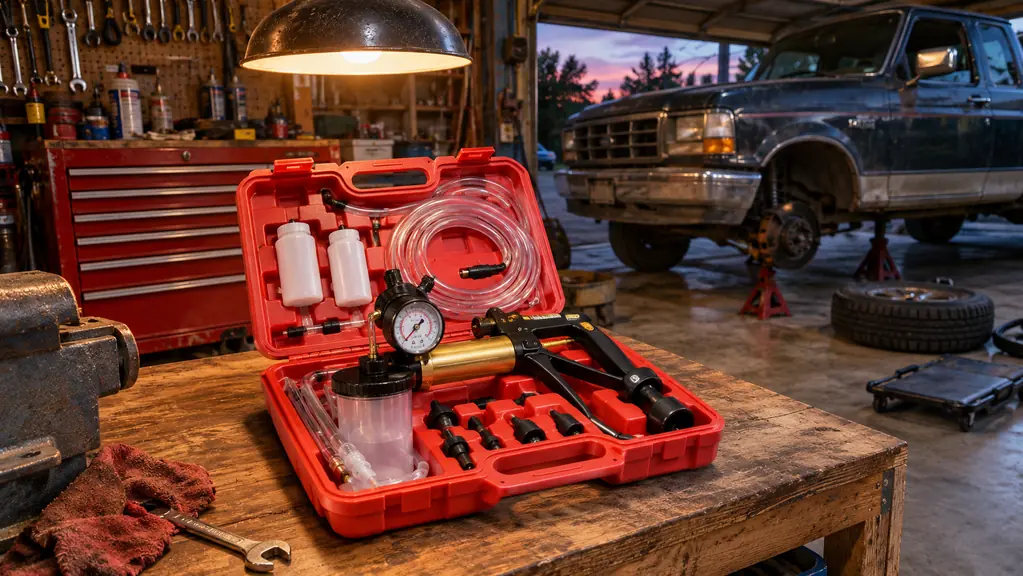
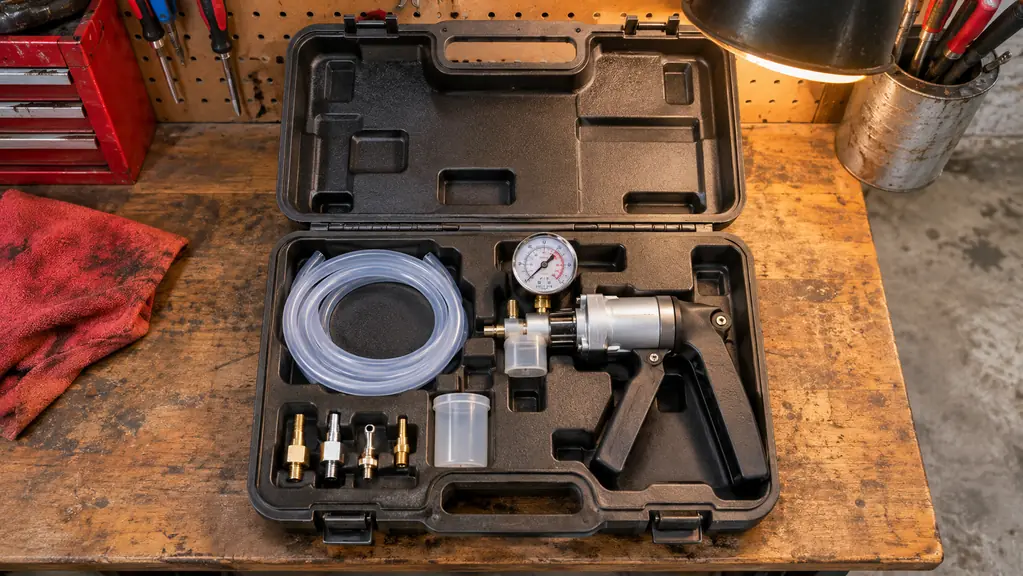
The kit shows up in a blow-molded storage case, and that was the first thing I noticed. Everything has a spot: the hand vacuum pump, the dial gauge, the silicone tubes, the adapter set. That matters more than you would think, because brake bleeding parts are small, and the whole job goes sideways if you are on your garage floor hunting for the right adapter with brake fluid on your hands. A case you can carry to the wheel is a case that keeps the job together.
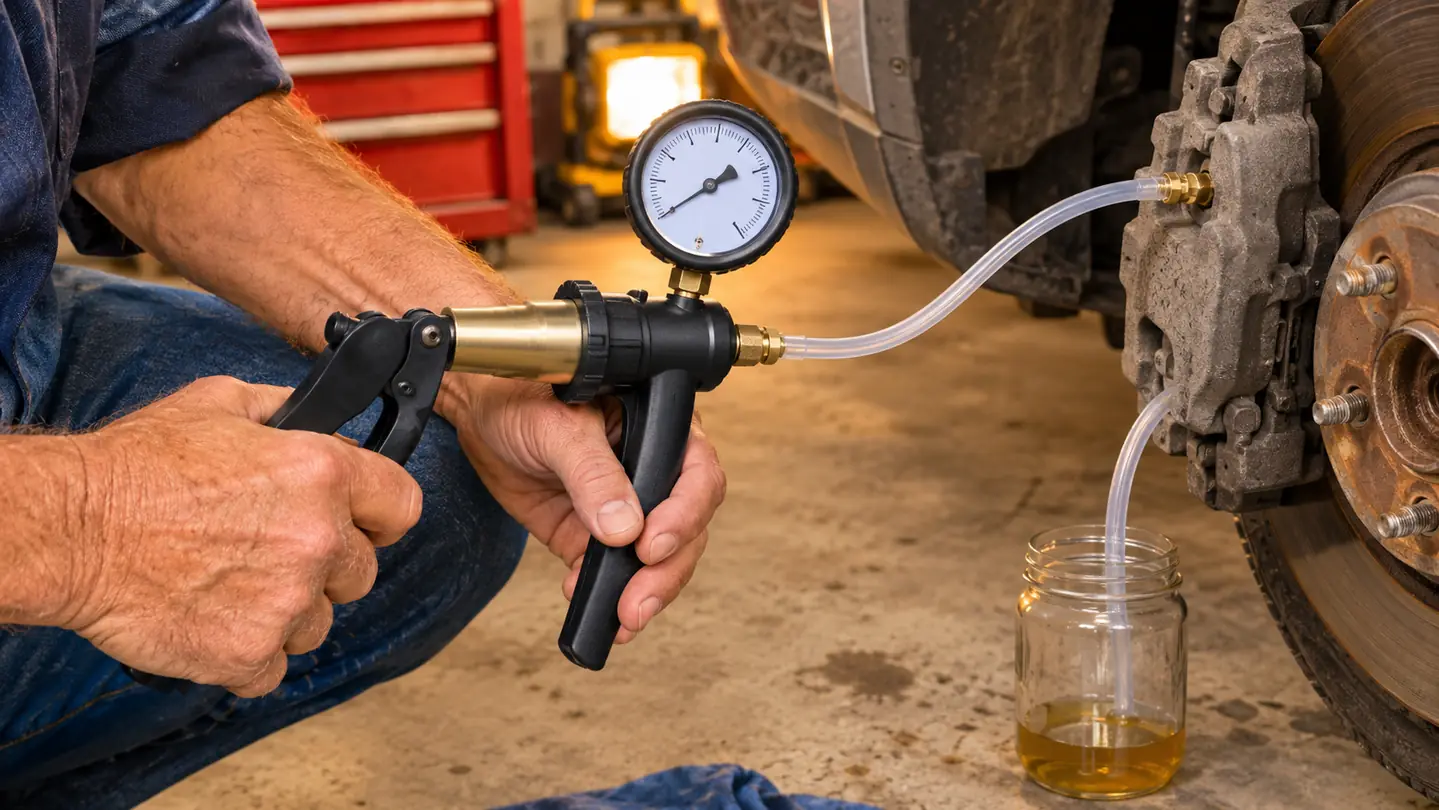
My first real job with it was the CR-V's front brakes. New pads, new rotors, and the calipers had been opened up, which means air in the lines. On a Honda you bleed the corner farthest from the master cylinder first, so I started at the passenger rear. I fit the silicone tube over the bleeder valve, opened the valve a quarter turn, and worked the hand pump. The dial gauge showed the vacuum building, and I could see the fluid moving through the tube as the air worked its way out. When the stream ran steady with no bubbles, I closed the valve and moved to the next corner. Four corners, one person, no yelling. That alone was worth the price of the kit, and I do not say that about many tools.
The honest part is that the first corner took me three tries. The bleeder valve on the CR-V is a small fitting, and if the tube is not seated just right, the pump pulls air around the threads instead of drawing fluid. You will see the needle on the dial gauge jump around when that happens, and you will wonder if the tool is broken. It is not. The fix is simple: smear a little brake fluid on the threads, seat the tube firmly, and try again. Nobody puts that in the listing, but it is the difference between a frustrating hour and a smooth one. Once you learn it, you will do it without thinking.
I also used it on the F-150 when I replaced a rear caliper last fall. Same story: one person, the hand pump, the gauge, and a clean jar under the tube. The adapter set had the right fitting for the Ford, and the bleed went faster the second time because I knew how to seat the tube. That is the thing about this tool. It rewards a little practice, and it does not punish you for being new at it.
What the Listing Doesn't Tell You
The first thing nobody tells you is that a hand vacuum pump is not a power bleeder. It is a hand pump. You are the motor. For one or two corners, that is nothing. For a full four-corner bleed with fresh fluid, you will trade hands a few times, and your forearm will let you know about it. That is not a flaw in the Orion Motor Tech kit. It is the nature of the tool. The kit does what it claims: it lets one person do the job. It just does not do it for you, and the sooner you make peace with that, the happier you will be with it.
The second thing is the dial gauge. It sits right on the pump, and it is genuinely useful, because you can watch the vacuum hold while you walk around to check the master cylinder reservoir. But it is a small gauge, and in a dim garage you will want your work light aimed at it. I backed the CR-V in so the shop light over my bench reached the wheel I was working on. Work with good light and you will read it fine. Work in the dark and you will be second-guessing every reading, and a job you are unsure about is a job you will end up doing twice.
The third thing is the case. The blow-molded storage case is a real plus, because it keeps the pump, the tubes, the adapters, and the gauge in one place, and it travels well when Travis brings his car over. But the parts are small, and if you open the case on a messy bench, something will wander off. I learned to set the case lid underneath the open case so I had a tray for the small pieces. Old mechanic habit. Works every time, and it is the kind of thing you only learn after you spend ten minutes looking for a fitting you dropped.
One more thing the listing does not tell you: the kit is not a flush machine. It bleeds air out of the system, and it pulls fresh fluid through when you open the valve, but you still have to manage the master cylinder yourself. I check the reservoir after every corner and top it off before I move on. Let it run dry and you will push air back into the system, and then you get to start over. That is true of any vacuum bleeder, but it is worth saying out loud, because most of the bad reviews this kind of tool gets come from people who let the reservoir run dry and blamed the pump.
Where It Shines
Where the Orion Motor Tech kit earns its keep is the one-person job. The whole point is that you do not need a second person, and it delivers on that. I bled the CR-V's brakes alone after the pad and rotor job, and the pedal came back firm. No coordinating. No 'push, hold, release' through the open door. No raised voices. Just me, the pump, and the gauge, and a pedal that felt like it should. For a Saturday job in a home garage, that is the whole ballgame.
The silicone tubes make a real difference. They seal well on the bleeder valves, they hold up to brake fluid, and they have not gone stiff and brittle the way some tubing does after a year in a garage. The adapter set covers the fittings on the F-150 and the CR-V, and the listing says it works with nearly any vehicle's system, which matches what I have seen in my own driveway. I cannot test every car on the road, but I can tell you it has not met a fitting it could not handle here.
The kit is also easy to keep straight. The case holds everything, the pump weighs about two pounds, and the whole thing fits on a shelf in my garage. When I am done, every part goes back in its spot, and the next time I need it, it is ready to go. That sounds like a small thing, but it is the difference between a tool you reach for and a tool you dig for. After a year, mine still looks like it did the day it arrived, which is more than I can say for most of what lives in my garage.
The dial gauge deserves its own mention. With the old two-person method, you never really know if you are pulling air until the pedal goes soft on the road. With this kit, you can watch the needle hold steady while you check the reservoir, and you can see the moment the system seals up. That feedback is worth something. It turns a blind job into a job you can watch, and for a home mechanic that is the difference between hoping the brakes are right and knowing they are.
Where It Falls Short
Now for the part I would tell you over the fence. The Orion Motor Tech kit is not the fastest way to bleed brakes. A pressure bleeder that pushes fluid from the master cylinder will do a full system in a fraction of the time, and a shop that does this all day should own one. For a home mechanic doing brakes once or twice a year, the hand pump is fine. Just be honest with yourself about how much time you want to spend pumping. If your idea of a good Saturday is getting the job done before the coffee gets cold, this is not the tool for you.
The other shortfall is the learning curve on the bleeder valves. If the tube does not seat well, you will pull air around the threads, and the gauge will show a vacuum that is not doing you any good. Once you learn the trick, it stops being an issue. But the first time out, it can make you wonder whether the tool is working. It is. You just have to get the seal right, and the only way to learn that is to do it once and pay attention to what the gauge tells you.
And one more honest note: the manual pump means your arm does the work. On a full flush, where you run fresh fluid through all four corners until it runs clear, your arm gets tired and your patience gets tested. Take breaks. Keep the master cylinder reservoir topped up. Do not rush. The job will come out right, but it will take the time it takes. I have learned that rushing a brake job is how you end up doing it twice, and the second time is always worse.
The kit is a vacuum tool, and it does vacuum work. If you are chasing a stubborn air pocket, sometimes the old gravity trick helps more than any pump: open the bleeder, let the system drip, and walk away for a while. I keep a length of hose and a jar for that too. The pump handles the routine jobs, and the old tricks handle the stubborn ones. Owning this kit does not mean forgetting everything else you know.
What I Liked
- Bleed brakes by yourself, no second person needed
- Dial gauge shows the vacuum holding while you work
- Silicone tubes seal well and hold up to brake fluid
- Adapter set covers the fittings on the F-150 and the CR-V
- Blow-molded case keeps every part organized
Where It Falls Short
- Manual pumping gets tiring on a full four-corner flush
- Small adapters are easy to lose if you are not careful
- Takes a few tries to get the tube seated right on the valve
- Slower than a shop power bleeder
I bled all four corners of the CR-V by myself in about an hour and a half, and the pedal came back firm. That is the whole story.
How It Compares to the Old Way
I have done brake bleeds every way there is: two-person pump and hold, a friend on the pedal with a length of hose, a one-way valve on the bleeder, and now this hand vacuum pump. The two-person method works, and it costs nothing, but it costs you a helper. The one-way valve trick is clever but slow, and you never quite trust it. The vacuum pump sits in the middle: it is faster than the valve, slower than a pressure bleeder, and it only needs one set of hands. For most home mechanics, that is the right place to be.
The biggest difference I noticed is control. With the old method, you are reacting to the pedal. With the pump, you are watching the gauge and the tube, and you decide when the corner is done. That changes the job. You stop guessing and start looking. For a home mechanic, that is the difference between a chore and a job you understand, and understanding the job is what keeps you from paying a shop to do it next time.
The tradeoff is the pumping. A pressure bleeder pushes fluid through the system while you sit there, and a shop that does this every day should own one. For the rest of us, a Saturday brake job comes around once or twice a year, and the extra ten minutes of pumping is a fair price to pay for not needing a second person. I will take that trade every time, and I suspect most of you will too once you have done it alone.
And if you are wondering whether the Orion Motor Tech kit is the one to get, here is my answer: it is the one I bought, and a year later it is still the one I reach for. The listing is accurate about what it is. The things it does not tell you are the small ones, and none of them have made me wish I had spent more money on a fancier setup. It does the job, it stays organized, and it does not cost an arm and a leg. That is a fair deal in any garage.
Who This Is For
This kit is for the home mechanic who works alone. If you keep your own cars running in a driveway or a one-car garage, if you have ever tried to bleed brakes with a helper who is not there when you need them, and if you want a tool that lives in its own case and does the job when you call on it, the Orion Motor Tech one-man brake bleeder is worth a hard look. It is also a good fit if you help your grown kids with their cars, because it travels in the trunk without taking up room. Travis has borrowed it more than once, and it comes back in the same shape it left in.
Who Should Skip It
Skip it if you want power bleeder speed, or if you do brake work for a living. A shop that bleeds brakes every week should own a pressure bleeder, not a hand pump. And if you only touch brakes once a decade, you might be better off borrowing one from a neighbor or using the old two-person method with a patient helper. The kit is a good value for what it does, but it is not a shortcut, and I will not pretend otherwise. Buy it because you work alone, not because you think it will turn a four-hour job into a twenty-minute one.
Work alone? This is the kit I would start with.
After a year with the Orion Motor Tech one-man brake bleeder, it is the tool I reach for when the CR-V or the F-150 needs a bleed. See what it goes for today and decide for yourself.
Amazon Check Today's Price on Amazon →