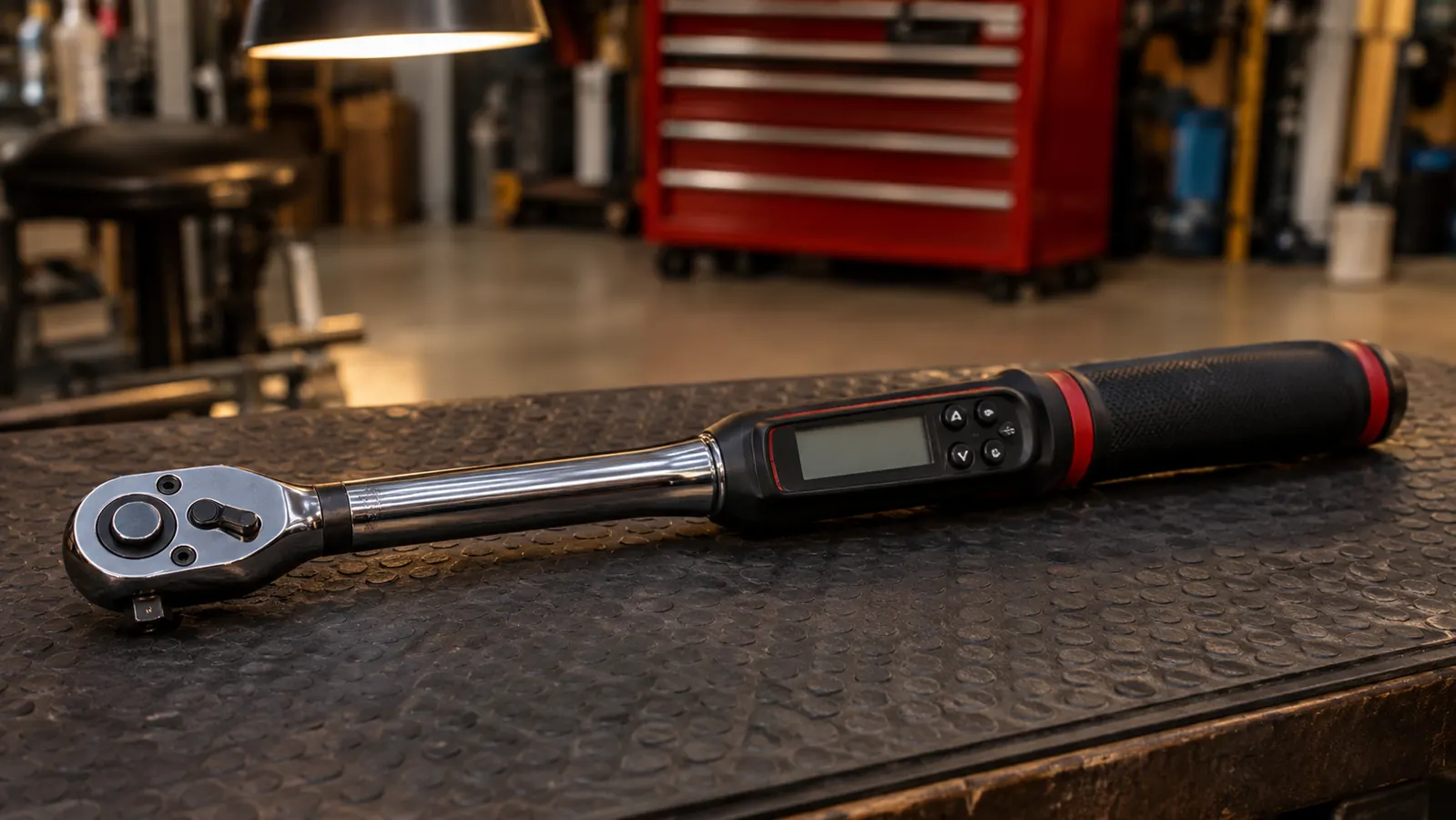
I will tell you the part the listing photos leave out: the GEARWRENCH 1/2 Drive Electronic Torque Wrench is not a tool you buy because it looks good on a pegboard. You buy it because it beeps, buzzes, and vibrates at the exact moment you need to stop pulling. I am Earl Dobbins, a retired heavy-equipment mechanic, and I have owned this wrench for about three years. It has torqued lug nuts on my 2011 F-150, caliper bracket bolts on my wife's 2016 Honda CR-V, and more spark plugs than I can count. Here is the honest review I would give a neighbor over the fence, including the parts that annoy me.
The Quick Verdict
A genuinely accurate electronic wrench that makes driveway torque work easier, but the battery door is fiddly and the flex head takes getting used to.
Amazon Check Today's Price →Torque the way you meant to, the first time
The GEARWRENCH electronic torque wrench warns you before you overshoot, so you stop cranking at the right number instead of guessing. Check today's price on Amazon.
Amazon Check Today's Price on Amazon →How I've Used It
I bought this GEARWRENCH about three years ago, after I got tired of the old click-type wrench I had been using since my county road department days. That one still worked, but my ears are not what they used to be, and I kept second-guessing whether I had actually felt the click or just imagined it. The electronic wrench removes all doubt. It vibrates in your hand, beeps, and lights an LED as you approach the target torque. You do not have to listen for anything.
The first job I used it on was a brake job on Marlene's CR-V. I had put new pads and rotors on the week before with the click wrench, and I spent the whole drive to the hardware store wondering whether I had left the caliper bracket bolts tight enough. With the GEARWRENCH, I set 36 ft-lb, pulled until the handle buzzed, and stopped. Then I did the other side and did not think about it again. That is the whole difference. The tool does not make you smarter. It just takes the guessing out of the job.
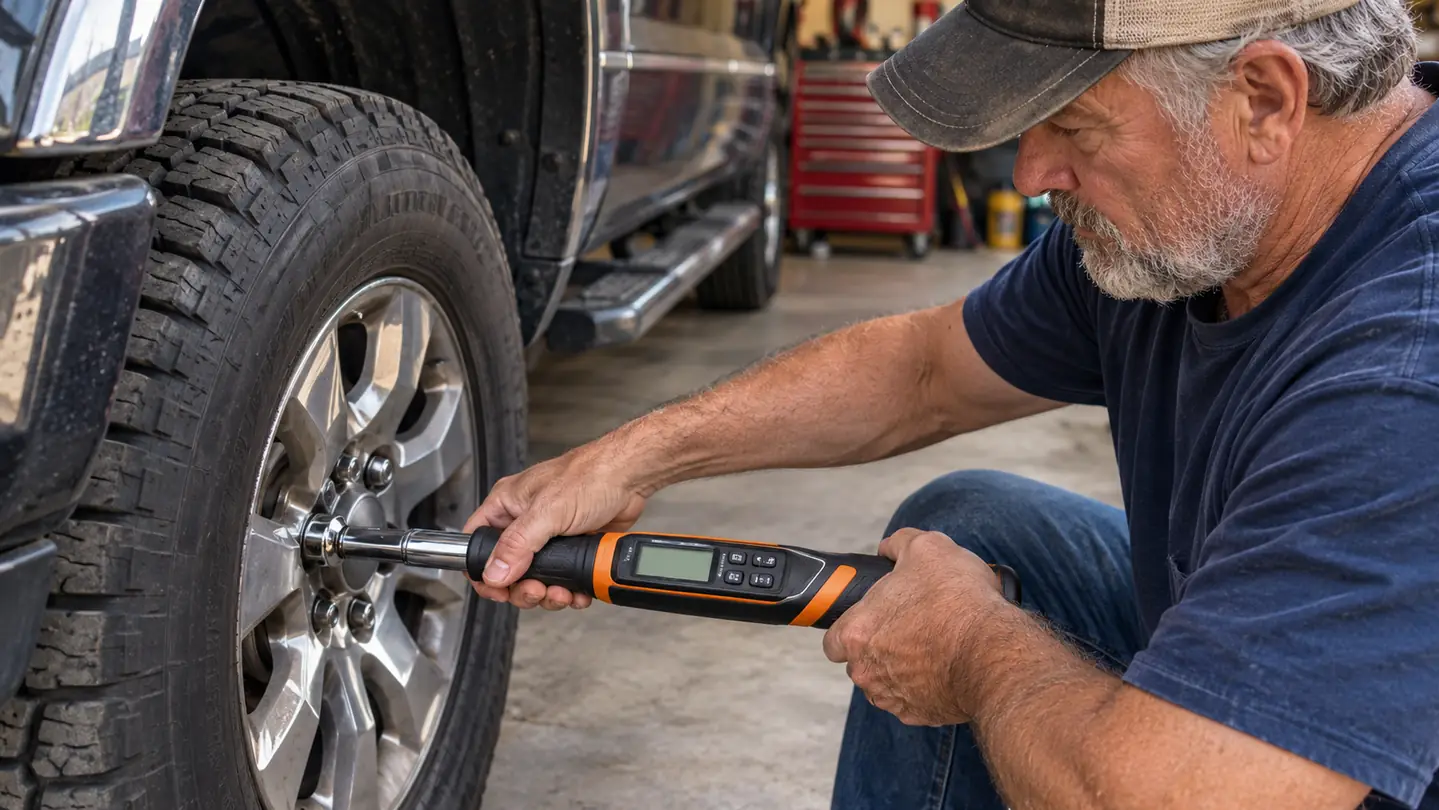
Since then it has torqued the lug nuts on the F-150 after every tire rotation, which I do twice a year, once in the spring and again before winter. My truck's lug nuts call for 150 ft-lb, and that sits right in the middle of the wrench's range, which is where the accuracy is best. It has also done spark plugs on both vehicles, the caliper bracket bolts on the CR-V, and the suspension bolts when I replaced the front sway bar links on the F-150 last summer. I set the number, pull until the handle vibrates, and stop. That is the whole job.
The 72-tooth ratchet with a 5 degree swing arc means I can also use it in tighter spots than my old wrench. That matters when you are leaning over a fender with your arm bent sideways, or when the fastener is tucked up behind the suspension. The old wrench needed a bigger swing to catch the next tooth, so I was forever pulling it off and re-seating it. This one catches sooner, and on a job where you are torquing a dozen fasteners, that adds up.
What Nobody Tells You Before You Buy
First, the flex head. The listing calls it a flex head, and that is exactly what it is, but the first time you use it, the head moving on you can feel like a defect. Mine arrived with the head straight, and the first time I leaned on it, it folded back on me like a hinge. I stopped, looked at it, and wondered if I had broken it on the first pull. I had not. The head is supposed to pivot so you can get the wrench onto a fastener at an angle. It is useful on caliper brackets and anything low on the engine, where a fixed head will not line up. Give yourself one job to get used to it. After that, you will not want a fixed head again.
Second, the batteries. The wrench requires 2 AA batteries, and they are not included. That is not a big deal, but it is the kind of thing people discover at 8 o'clock on a Saturday morning with the truck on jack stands. I know because that is exactly how I found out. I had the F-150 up, the wheel off, and the manual in my hand, and there was no power in the wrench. I keep a drawer of spare batteries in the garage now, but I did not that day. Buy the batteries before you need them.
Third, the hang hole at the end is more useful than it sounds, but I do not use it. I keep the wrench in the drawer with the batteries out, because I do not want a slow drain to leave me with a dead wrench at the wrong moment. A torque wrench is a precision tool, and I treat it the way I treated the torque wrenches at the county shop. It gets its own spot in the drawer. It does not get thrown in with the sockets. And it does not get used to break fasteners loose. The listing says the calibration accuracy is warrantied for 90 days and the wrench itself for a year. I have never needed to test that warranty, but it is good to know it is there.
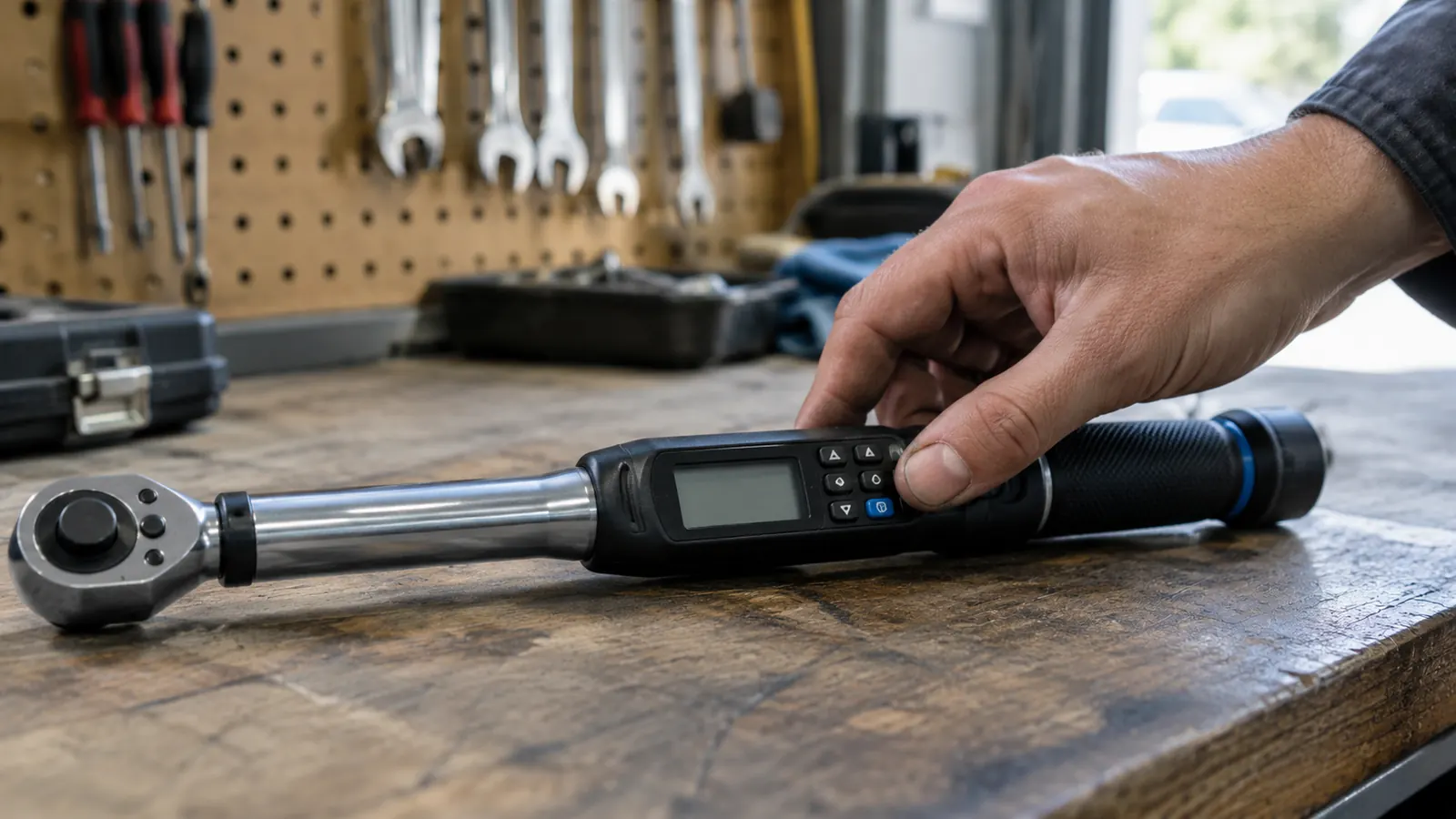
One more thing nobody tells you: you do not need to watch the display while you pull. The alert is the whole point. The first few times I used the wrench, I kept glancing at the numbers out of habit. After a week, I stopped. Your hand feels the buzz, your ears hear the beep, and the LED is there if you want it. The tool tells you the answer three different ways, so you can keep your eyes on the fastener.
I stopped second-guessing my old click wrench the day I felt the handle buzz at exactly the number I had set.
Accuracy and the Specs That Matter
The numbers that matter on any torque wrench are the accuracy numbers. GEARWRENCH rates this one at +/-2% clockwise and +/-3% counterclockwise, between 20% and 100% of the wrench's capability. That is a solid spec for a home garage. It is not a laboratory instrument, and I would not use it to build a racing engine, but for lug nuts, suspension bolts, and anything else on a street vehicle, it is more accurate than I need.
The wrench covers 30 to 340 Nm, which in the units I actually think in is roughly 22 to 250 ft-lb. That range handles just about everything on a half-ton pickup or a family SUV. My F-150's lug nuts spec at 150 ft-lb, right in the middle of the range. The CR-V's caliper bracket bolts are lower, around 36 ft-lb, and the wrench handles those too. But here is the part the listing does not spell out: the accuracy rating only applies between 20% and 100% of the wrench's capability, which works out to about 50 to 250 ft-lb. That 36 ft-lb caliper bolt sits just under the rated window. In practice the wrench has been consistent for me down there, and I check it against a beam wrench every so often, but if most of your work is small fasteners, a smaller wrench rated for lower torque might suit you better.
One thing I appreciate is that the display gives you five torque measurement units: Nm, ft-lb, in-lb, Kgf-m, and Kgf-cm. I work in ft-lb, but my son Travis works on a Japanese car and thinks in Nm. Being able to switch units on the same tool means we do not need two wrenches in the garage. When he brought his car over last fall for a brake job, he set the wrench to Nm, torqued his caliper bolts, and handed it back. No conversion chart, no math, no arguments about which unit is right.
I also checked the GEARWRENCH against the beam-style torque wrench I keep in the drawer, the kind with the needle that bends. I set both to 80 ft-lb and torqued the same bolt. The beam wrench read about 80, and the GEARWRENCH buzzed right where I expected it to. That is not a laboratory calibration, but it told me the electronics and the mechanical gauge agree well enough for driveway work. If I were building engines for a living, I would send it out for calibration every year. For lug nuts and brake brackets, I trust it.
Where It Shines
The target torque alert is the reason to buy this wrench. As you approach the set number, the handle vibrates, a buzzer sounds, and an LED light comes on. You do not have to watch the display while you pull. You can keep your eyes on the fastener and your mind on the job, and your hand will tell you when to stop. For a guy who has spent 30 years with a click wrench, that is a genuine improvement.
The alert is a warning, not a stop. It fires as you approach the target, so you slow down and finish the last little bit by feel. If it only went off at the exact number, you would overshoot every time, because your hand cannot stop instantly. As it is, the wrench gives you a moment to ease off, and the final pull lands where it should. The first time I felt it, I was torquing lug nuts on the F-150. I stopped about halfway through the warning, finished the pull, and checked the display. It read 150. I did not have to think about it again.
It also shines on brake jobs. When I did the pads and rotors on Marlene's CR-V, I used this GEARWRENCH on the caliper bracket bolts. Those bolts are easy to strip if you lean on them too hard, and the alert caught me before I overshot more than once. On the driver's side, the top bolt is tucked up where you cannot see it. With a click wrench, I would have been guessing. With the GEARWRENCH, I just pulled until it buzzed. The same goes for spark plugs. I have seen too many aluminum heads ruined by someone who thought good and tight was a torque spec.
It also earns its keep twice a year when I rotate the tires on the F-150. I do it in the spring and again before winter, and each time I torque the lug nuts on all four corners to 150 ft-lb. That is twenty fasteners per rotation, and the wrench makes every one of them the same. With my old click wrench, I would get into a rhythm and start hurrying, and I could never be sure the last few were as tight as the first. The GEARWRENCH does not care about my rhythm. It buzzes at the same number every time.
Where It Falls Short
The honest part: the battery door is fiddly. It is a small sliding cover, and with my fingers, it takes more patience than it should. The first time I changed the batteries, I spent a good five minutes working the cover back and forth before it gave up. It is not a reason to avoid the wrench, but it is the first thing I would change if I ran the company.
The flex head also has a learning curve. If you are used to a solid head, the first few pulls feel odd, and you may find yourself re-seating the wrench on the fastener more than once. It is a tradeoff. You gain access to tight spots, and you lose a little of the set it and forget it feel of a fixed head. By the third job, I stopped noticing it, but the first afternoon was not smooth.
And it is not a replacement for a breaker bar. The wrench is 25.65 inches long and weighs 3 pounds, which is fine for torquing, but I do not use it to break a rusted lug nut loose. I crack the fastener with a breaker bar, then use the GEARWRENCH for the final pull. That is just respecting the tool. A torque wrench measures, it does not fight.
What I Liked
- Vibrating handle, buzzer, and LED alert make it obvious when you hit target torque
- +/-2% clockwise accuracy is plenty for home and driveway work
- 72-tooth ratchet with a 5 degree swing arc works in tight spots
- Five torque units cover ft-lb, Nm, in-lb, Kgf-m, and Kgf-cm
- Flex head reaches caliper brackets and awkward angles
Where It Falls Short
- Battery door is fiddly and takes patience to open
- Flex head takes a job or two to get used to
- Requires 2 AA batteries that are not included
- Not meant for breaking fasteners loose
Who This Is For
This GEARWRENCH is for the DIY home mechanic who does their own brakes, suspension, and tune-ups and wants the fasteners done right the first time. If you have ever torqued a lug nut by feel and spent the next week wondering if it was tight enough, this wrench ends that. It is also for anyone who has a hard time hearing a click-type wrench, or who works in a spot where they cannot see the head. The buzz and the LED do the communicating for you.
Who Should Skip It
If you only change a tire once a year, a cheaper click-type wrench will do the job and you will not miss the electronics. If you need a tool for breaking rusted fasteners loose, this is not it, and no torque wrench is. And if you are the kind of person who will not read the manual and will not buy spare batteries, the electronic bits will eventually frustrate you. The wrench is not complicated, but it does expect a little from you. It wants batteries, it wants to be stored flat in a drawer, and it wants you to set the number before you start pulling. None of that is hard. It just is not zero maintenance.
The Bottom Line
After three years, I still reach for the GEARWRENCH electronic torque wrench for every job that calls for a torque spec. It has never let me down. The accuracy is there when I need it, the alert saves me from my own enthusiasm, and the flex head earns its keep on brake jobs. The fiddly battery door and the learning curve are small prices to pay for knowing the lug nuts on my truck are right. If you are on the fence, that is the honest summary: it is not perfect, but it is the wrench I grab first.
Stop guessing, start torquing
If you are tired of second-guessing your click wrench, the GEARWRENCH electronic torque wrench is a solid upgrade. Check today's price on Amazon.
Amazon Check Today's Price on Amazon →